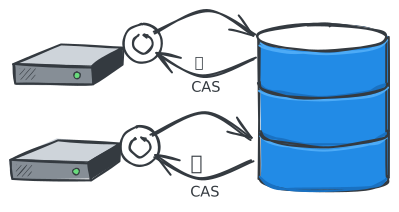
Today we will explore how to leverage atomic operations without opening a multi-statement transaction, increasing the system’s write throughput without sacrificing correctness.
To avoid conflicts with other processes changing the same data, we can lock the rows before
updating them, for example with SELECT ... FOR UPDATE.
This approach has drawbacks: locks consume database resources for the entire duration of the
transaction and can lead to lock contention as writers wait for one another, reducing write throughput.
It is generally preferable for transactions to be short.
Some operations can instead be expressed optimistically. Rather than explicitly locking a resource up front so that no other process can modify it (pessimistic concurrency control), we assume everything will be fine (optimistic concurrency control), proceed, and resolve conflicts only when they occur. Optimistic concurrency control allows for higher throughput when the number of conflicts is small because locks are held only briefly. However, it requires a conflict resolution mechanism, such as retrying the operation.
Commutative operations
Let’s first look at operations that do not require conflict resolution. Operations are commutative when their order does not matter, as with addition: changing the order does not change the result. We will review several examples and see how to implement them.
Collecting unique values
Let’s say we have an auction system. We want to collect the unique users who have bid on an item. A simple table might look like this:
CREATE TABLE bidders (
  id      BIGINT GENERATED ALWAYS AS IDENTITY,
  item_id BIGINT NOT NULL,
  user_id BIGINT NOT NULL
);
Because we want to store only unique user_id bid on item item_id only once,
we add a unique index on it:
CREATE UNIQUE INDEX unique_item_bidder_idx ON bidders(user_id, item_id);
Collecting bidders is then a simple atomic operation. If the user has already bid on this item, we ignore the duplicate:
INSERT INTO bidders(item_id, user_id) VALUES
($1, $2)
ON CONFLICT (item_id, user_id) DO NOTHING;
This way, we neither need to explicitly lock anything nor care about the order of the actions: adding values to a set is commutative.
Collecting MAX values
Now, let’s collect the maximum bid for each item. We have a table that stores the maximum bid
for an item and the user who made it (user_id):
CREATE TABLE max_bids (
  id         BIGINT GENERATED ALWAYS AS IDENTITY,
  item_id    BIGINT NOT NULL,
  user_id    BIGINT NOT NULL,
  bid        NUMERIC NOT NULL
);
There can be only one maximum bid per item, so we create a unique index on item_id.
CREATE UNIQUE INDEX unique_bids_idx ON max_bids(item_id);
When we insert a new bid, it is added if the item item_id has no bid yet.
If the item_id already has a bid (ON CONFLICT (item_id)), we update that row
only if the new bid is higher (WHERE EXCLUDED.bid > max_bids.bid):
INSERT INTO max_bids (item_id, user_id, bid)
VALUES ($1, $2, $3)
ON CONFLICT (item_id) DO UPDATE
    SET bid        = EXCLUDED.bid,
        user_id    = EXCLUDED.user_id
    WHERE EXCLUDED.bid > max_bids.bid;
If we need to know whether the value changed (inserted or updated), we can check the
number of affected rows. It will be 0 if the bid was neither inserted nor updated.
Most database libraries expose this information. For example, Go provides
sql.Result.RowsAffected().
Incrementing a counter
Now, let’s say we want to know how many times each item has received a bid. For each item, we have a counter that tracks the number of bids:
CREATE TABLE bids_count (
  id         BIGINT GENERATED ALWAYS AS IDENTITY,
  item_id    BIGINT NOT NULL,
  "count"    INT NOT NULL DEFAULT 1
);
Again, because we want to track the count per item_id, we need a unique index on it.
CREATE UNIQUE INDEX unique_bids_count_idx ON bids_count(item_id);
Updating the count is a single atomic operation count = count + 1:
INSERT INTO bids_count(item_id)
VALUES ($1)
ON CONFLICT (item_id) DO UPDATE
SET "count" = bids_count."count" + 1;
Conditional writes
When an operation cannot be expressed in a commutative form, we can use a conditional update to
avoid wotking with the stale data. Assume each user has a wallet in which we track
their balance and the reserved amount for the bids:
CREATE TABLE wallets (
  user_id  BIGINT PRIMARY KEY,
  balance  NUMERIC NOT NULL,
  reserved NUMERIC NOT NULL DEFAULT 0,
  version  BIGINT NOT NULL DEFAULT 0
);
Multiple processes can try to update the same wallet at the same time: a user might place several
bids at once, or a bidding bot might submit them in parallel. Placing a bid is a read-modify-write
operation: we read the wallet, calculate the new balance and reserved values in application
code, and write them back. If we blindly read and then update, another transaction can change the
state between our read and write, causing us to overwrite its result (a lost update).
One option is to do this pessimistically by locking the row:
BEGIN;

SELECT balance, reserved, version
FROM wallets
WHERE user_id = $1
FOR UPDATE;

-- updates

COMMIT;
FOR UPDATE prevents other transactions from modifying the row while the lock is held.
The problem is lock contention: any other transaction that wants to update this row must wait.
Another option is to do this optimistically with compare-and-swap (CAS), updating a record only
if it has not changed. First, read the row without an explicit lock (FOR UPDATE):
SELECT balance, reserved, version
FROM wallets
WHERE user_id = $1;
Then update it only if nothing has changed since we read it:
UPDATE wallets
SET balance = $1, reserved = $2
WHERE user_id = $3 AND balance = $4 AND reserved = $5;
The number of affected rows tells us whether the update succeeded: 1 means that it did, while 0 - either the values changed or the row no longer exist.
Comparing values does not detect an ABA problem: a value can change from 100 to 50 and back to 100 before the update. This is harmless when the operation depends only on the the compared values. But, it may be incorrect in other use cases, for example when transitions produce side effects (e.g. sending email) or correctness depends on the state has not been changed.
This is where a version comes into play. In this case, the version is a monotonically increasing value. All writers must follow the rule: whenever the object is updated, it must increment object’s version. Each update creates a new version, allowing us to detect any concurrent changes.
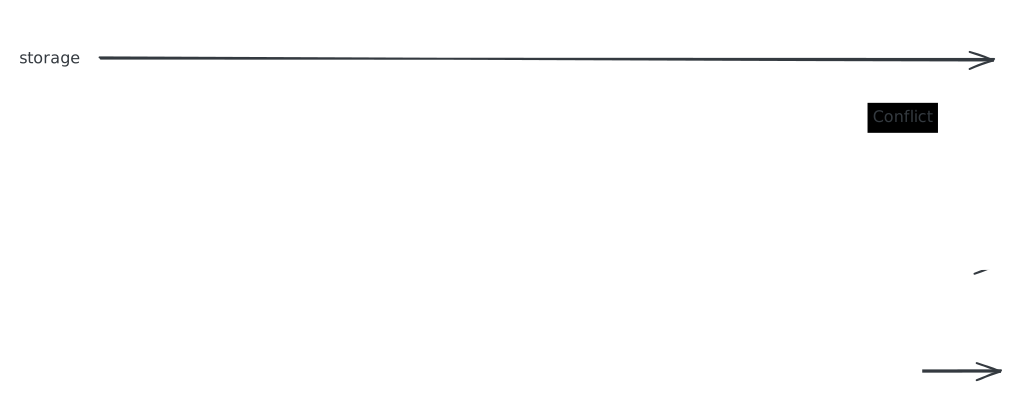
For example, assume we have the balance 100 at version 10. One process changes the balance to 50 and the version to 11, and then another process changes the balance back to 100 and the version to 12. When the original process, which read version 10, tries to update the balance and receives a conflict - no rows updated.
The update is then simply:
UPDATE wallets
SET balance = $1, reserved = $2, version = version + 1
WHERE user_id = $3 AND version = $4;
The number of affected rows tells us whether the update occurred. If it is 0, another writer has
modified the row, and the application must retry: read the latest values, recalculate balance and
reserved, and attempt to store them again.