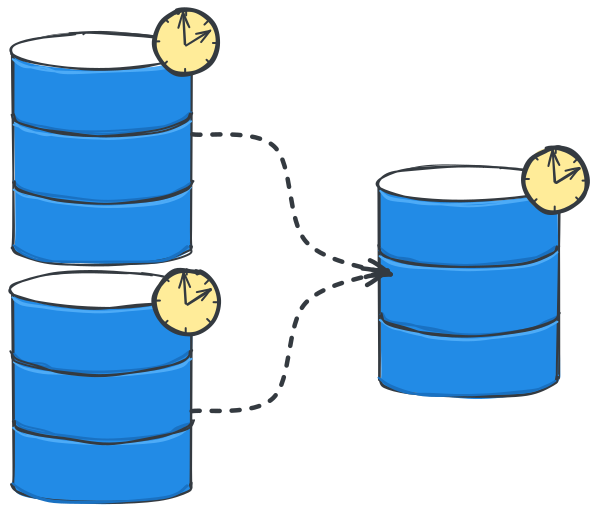
Conflict-free Replicated Data Types (CRDTs) are mostly known for their use in collaborative software, like collaborative editing tools, where users can edit a document offline and the changes will be synced, merged and conflicts resolved automatically. The name CRDT is a little bit misleading: not that there are no conflicts, just that conflict resolution is built into the data type itself.
We will look at them from the perspective of event-driven distributed systems. You will see that they are closely related and that lessons from CRDTs are directly applicable to event-driven systems. First, some definitions.
Total order
As the name implies, this is when we know the total order of events. For example, in a bank account, we have an ordered log of all deposits and withdrawals:
+$100 -$80 +$20 -$40
The order is important here: if we change the order of events, we’ll get an overdraft:
+$100 -$80 -$40 = -$20, oops, overdraft!
A total order is a time-ordered log of all changes, from the creation of the object to its death. In this case, it can be a log of all operations from the opening of the bank account to its closing.
In databases, each transaction is an event. At the serializable isolation level (the highest one), a database uses different kinds of tricks to guarantee that transactions appear to be executed in serial order, one after another. This means transactions are in total order.
Partial order
Causal order - happened before - means one event happened before another, we do not have or do not need the total order of all events. Causality just means that you know what caused what.
For example, we have user login-logout events in a Kafka topic.
user1 events are always stored in partition 1, user2 events are stored
in partition 2. Events for user1 are causally ordered, e.g. logout cannot
happen before login:
partition 1: (user1 login)                               (user1 logout)
partition 2:                (user2 login) (user2 logout)
Events for user1 and user2 are concurrent. Events for user2 may or
may not happen before events for user1 in total order, and, frankly,
we don’t care. We also may process events not in the total order,
e.g. process user1 login after user2 login.
When we do not care about the total order of events, it is known as optimistic replication.
Commutative operations
Sometimes, you don’t even need a partial order. For commutative operations, like adding numbers, the order is not important. Now, will look at CRDTs from the perspective of event-driven systems.
Grow-Only Counter
A good example is a distributed counter. Imagine a like button on a YouTube video. Every time a user clicks +1, an event is sent. To calculate the total number of likes, you just count all the click events:
+1 +1 +1 ... +1 => sum()
There can be multiple levels of aggregation:
+1 +1 +1 ... +1 => sum() => +5 +7 ...\
                                      => sum() => +20 +37 ...
+1 +1 +1 ... +1 => sum() => +2 +1 .../
sum is commutative: in whatever order we process the events, the result will be the same.
The same works for dislikes: you have one positive counter and one negative counter, and the total count will be the positive count minus the negative count.
Grow-Only Counter is the first CRDT we have encountered.
Max-Register
Imagine an auction system, where bids arrive from many clients across distributed replicas. Each replica tracks the highest bid for the item. Whenever a new bid arrives, we compare it with the current highest bid. If it is higher, we update the highest bid, if not, we ignore it.
ReplicaA -> $100, $50, $120 => max() => $120  \
                                               => max() => $160
ReplicaB -> $110, $130, $160 => max() => $160 /
This is known as Max-Register. The max function is commutative: the order
of operations does not affect the result.
Grow-only Set
Back to our YouTube video, we want to track all unique users who watched the video. We can have a set of user IDs and whenever we receive an event, we check if the user ID is already in the set. If not, we add it, if yes - ignore it.
ReplicaA -> 1, 2, 1 => set => {1, 2}    \
                                         => set => {1, 2, 3, 4}
ReplicaB -> 2, 3, 4 => set => {2, 3, 4} /
This is known as Grow-only Set. It only allows adds, once added, an element cannot be removed.
Restoring order of events
In partially ordered systems, it is still possible to get the order of events after the fact. This is done by using logical clocks. The common choices are Lamport timestamp for global ordering:
timestamp -> process() -> timestamp + 1
When a system produces an event, it adds a logical timestamp to it -
an always-increasing value. This can be a simple counter for all produced events,
so each new produced event has timestamp = timestamp + 1.
Another option is Vector clock for causality between events. Vector clock is a vector of timestamps, where each part of the system increases only its part of the vector.
NodeA: -> (1, 0, 0) -> NodeB: merge((1,0,0), (0,0,0)) = (1,0,0) -> (1, 1, 0)
In this example, NodeA produces an event with timestamp (1, 0, 0). It increments only its part of the clock. NodeB receives the event, it does not have knowledge about this event, so it merges the received event with its own state (0, 0, 0), increases its part of the clock and emits event (1, 1, 0). By reading timestamp (1, 1, 0), you know that the event was influenced by NodeA and NodeB.
note
Using an actual clock for timestamps is a bad idea. Clocks are often out of sync, two computers in the same room can have a difference of tens of minutes. Imagine processing tens of thousands of events per second: a microsecond drift of the clock may cause big problems.
Let’s say we have processed events in the order:
(1),(3),(2),(4)
Restoring the total order is fairly simple: order events by timestamp.
(1),(2),(3),(4)
Conflict resolution
When events are produced from multiple replicas, the timestamp often includes
replica ID for conflict resolution. Imagine two replicas updating users
user1 and user2 simultaneously and producing events on each update.
Each event has a logical timestamp (counter, replicaID):
ReplicaA -> user1(1,A),user2(2,A),user1(3,A)
ReplicaB -> user1(2,B),user2(3,B),user1(4,B)
Events are ordered by the counter component of the timestamp, and replicaID is used to resolve the conflict on ties.
- At timestamp
1we have only one eventuser1(1,A), so it is the first event. - At timestamp
2we have two eventsuser2(2,A)anduser1(2,B), so we need to decide which one goes first. We can use replica ID to resolve the conflict:Agoes beforeB, souser2(2,A)goes beforeuser1(2,B). - At timestamp
3there is a similar situation, we resolve the conflict by replica ID, souser1(3,A)goes beforeuser2(3,B).
Total order will be:
user1(1,A),user2(2,A),user1(2,B),user1(3,A),user2(3,B),user1(4,B)
This conflict resolution is known as Last-Write-Wins (LWW).
Types of CRDTs
The problem can happen when events are not just a log, which can be reordered, but changes that are applied to the object.
Looking back at our user change events example. If a user changes
their username, the system can send only the change, for example
{userId: 123, username: biggus-dickus-69}
or you can send the whole state of the user object
{userId: 123, username: biggus-dickus-69, email: ..., phone: ...}.
When you are providing only changes, it is called an Operation-Based CRDT. When you are distributing the whole state, it is called a State-Based CRDT. Both have their pros and cons. Operation-Based CRDTs are smaller, as you propagate only the change, but have more complex conflict resolution. State-Based CRDTs are bigger, but conflict resolution is simpler.
Imagine you have a system that reads user changes from ReplicaA and ReplicaB
and applies these changes to an object. For a short amount of time,
you lost a connection to ReplicaB and were processing events only
from ReplicaA. You processed u1(1,A),u2(2,A),u1(3,A), then the connection
got fixed and you are processing u1(2,B),u2(3,B),u1(4,B).
ReplicaA: u1(1,A),u2(2,A),u1(3,A)

ReplicaB: --- broken connection ---  u1(2,B),u2(3,B),u1(4,B)
You need to restore the order of events to get to the correct state of the user.
In the case of State-Based CRDTs (whole state propagated), you just need to
process events that have a bigger timestamp than you already have.
For our example, before the connection is restored, we have entities at
version u1(3,A),u2(2,A), so we can skip events with lower timestamps and
process only u2(3,B),u1(4,B).
user1 has a version (3,A)
u1(3,A) > u1(2,B) => u1(3,A) // skip processing
u1(3,A) < u1(4,B) => u1(4,B) // apply

user2 has a version (2,A)
u2(2,A) < u2(3,B) => u2(3,B) // apply
In the case of Operation-Based CRDTs (only changes propagated), things get more
complex. The solution is to undo all events up to u1(1,A) and re-apply events
in the correct order. This approach is known as a time-warp.
u1(1,A),u2(2,A),u1(3,A)──┐
u1(1,A),u2(2,A) ◀──undo──┘
u1(1,A)
  ┌─redo──┐
  │       ▼
u1(1,A),u1(2,B)
u1(1,A),u1(2,B),u2(2,A)
u1(1,A),u1(2,B),u2(2,A),u1(3,A)
u1(1,A),u1(2,B),u2(2,A),u1(3,A),u2(3,B)
u1(1,A),u1(2,B),u2(2,A),u1(3,A),u2(3,B),u1(4,B)
This process can be expensive, as we need to store the different states of the object to be able to undo. Also, this can have unexpected external side effects. For example, we had a state that tells the system to send an email about the successful booking of a flight, but later, we receive an event that happened earlier, telling us that the flight was actually cancelled before the booking happened. Now we need a “compensation” action, e.g. send an apology email explaining the situation, which may or may not be acceptable depending on the use-case.
Sequence CRDTs
We were talking about all of this above in terms of events, but it also applies to collaborative editors. Each change (a character added, an item in the list moved, etc.) is an event. All events are stored in a sequence, which is the same as an event log. When several users edit the document offline and then the document is synced, the editor receives sequences (logs of events) from the users and merges them together to receive a total order of events.
For example, we have a document with “Hello World” text in it. Each symbol in the text gets assigned an index. These indexes are constant and do not change:
 H   e   l   l   o   _   W   o   r   l    d
1.0 2.0 3.0 4.0 5.0 6.0 7.0 8.0 9.0 10.0 11.0
If you look at it, the sequence is like event log, which is totally ordered and the index is like a logical clock.
Let’s say, there are two users, A and B, both editing document offline.
User A adds an exclamation mark ! at the end. It gets assigned a new index:
 H   e   l   l   o   _   W   o   r   l    d    !
1.0 2.0 3.0 4.0 5.0 6.0 7.0 8.0 9.0 10.0 11.0 12.0
At the same time, user B adds a comma , after o, it gets assigned a new
index between 5.0 and 6.0:
 H   e   l   l   o   ,   _   W   o   r   l    d
1.0 2.0 3.0 4.0 5.0 5.5 6.0 7.0 8.0 9.0 10.0 11.0
Synchronization happens, both editors receive each other’s sequences and merge the changes:
 H   e   l   l   o   ,   _   W   o   r   l    d    !
1.0 2.0 3.0 4.0 5.0 5.5 6.0 7.0 8.0 9.0 10.0 11.0 12.0
In this example, we are using floating-point numbers, so we can get a very large number of in-between indexes. In practice, variable-depth integers are used, like LOGOOT and LSEQ.
There are different implementations of collaborative editors, under the hood they differ in how they resolve conflicts and store sequences, but at their core they are using CRDTs to avoid conflicts.
Conclusion
The world of CRDTs and collaborative editors is very close to event-based distributed systems.
- If you look hard enough, event-driven services are kind of eventually consistent replicas of each other, with different views on the same data.
- Try to avoid conflicts, use commutative operations where possible.
- Use logical clocks to get a causal order of events if order is important.